Gasoline Engine Assembly Line
The assembly line utilizes a straight-lin[…]
Email:[email protected]
Email :[email protected]
Telephone :+86-181-3361-0489
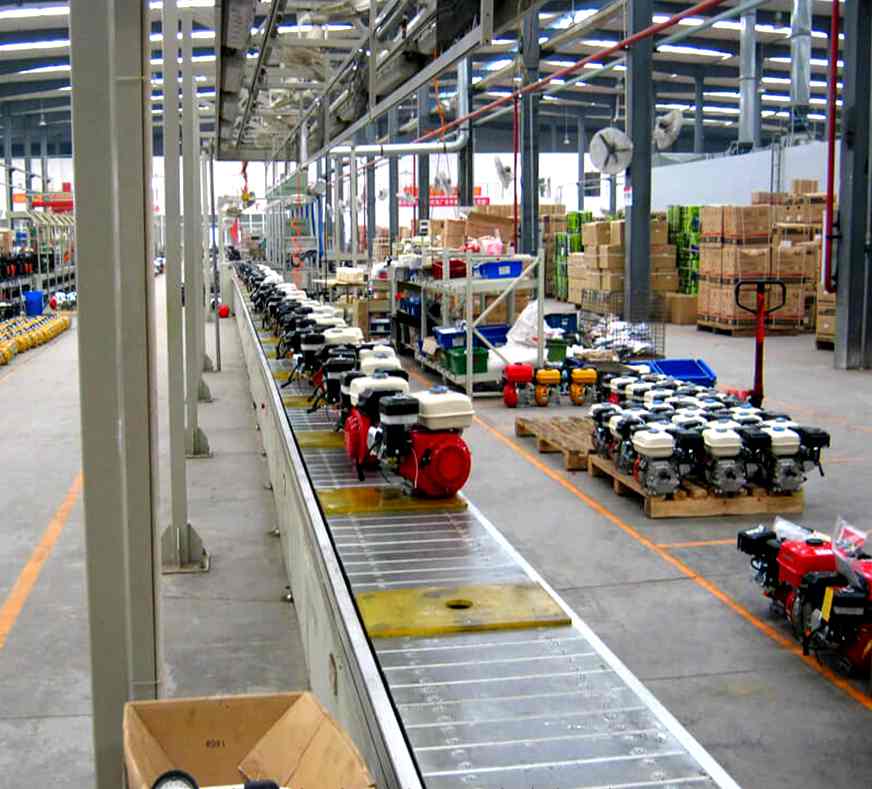
The assembly line utilizes a straight-line configuration, serving as a quintessential microcosm of the small general machinery manufacturing industry. Unlike the cutting-edge automation found in automotive engine production, this line relies on mature process takt times and skilled manual labor to assemble thousands of components into reliable power cores.
I. Detailed Workstation Breakdown
From Raw Casting to Finished Product
The line employs an accumulation roller conveyor system with inverter-controlled speed regulation, ensuring sufficient cycle time for each workstation.
1. Loading Station (Body-in-White)
Located at the far end of the line, this is the starting point. Operators hoist die-cast aluminum alloy crankcases onto the roller conveyor. At this stage, the engine block is merely a shell, with the crankshaft and pistons yet to be installed. Adjacent material racks are neatly stocked with gears, bearings, and shims, reflecting a typical “Supermarket” style of material supply.
2. Core Assembly Area
As the line advances slowly, the engine enters its critical assembly phase.
Motion Component Installation: Workers sequentially install the crankshaft assembly and the connecting rod-piston group—the lifeblood of the engine. Strict control over piston ring end gap is mandatory to prevent oil burning or cylinder scoring.
Cylinder Head Sub-Assembly: This is the most critical torque control point. Operators use torque-controlled electric wrenches to tighten cylinder head bolts in a strict diagonal sequence. The bright red engines seen here have completed cylinder head cover installation, exposing their black cooling fins.
Ignition Timing & Setup: Spark plugs are installed, and the magneto (stator) position is adjusted to set the precise ignition advance angle, ensuring immediate start-up capability.
3. Peripheral Component Mounting
Upon reaching the mid-section of the line, the engine is fitted with its “outerwear.”
Air Cleaner: The white rectangular blocks on top are air cleaners, responsible for filtering dust to protect the internal cylinder walls.
Muffler & Brackets: The black components on the side include the muffler mounting flange, vibration-damping feet for generators or water pumps, and fuel tank brackets.
Blower Housing: Installation of the black plastic or metal blower housing to construct the ducting for the forced-air cooling system.
4. End-of-Line (EOL) Testing
By the end of the conveyor, the red engine is capable of independent operation. Operators connect temporary fuel lines for a brief “fire-up test,” listening for abnormal noises. Subsequently, units are transferred to a dedicated dynamometer room for power output verification and durability testing, ultimately serving as the power source for generators, water pumps, or tillers.
II. Technical Specifications & Analysis
This line represents a classic Discrete Manufacturing Assembly Line, primarily focused on the standardized assembly of single-cylinder, 4-stroke, air-cooled gasoline engines (General Models: 168F / 170F / 188F series).
Production Line Hardware Configuration
Conveyance System: Accumulation roller conveyor, VFD speed control, width approx. 800mm–1000mm.
Workstation Layout: Linear or U-shaped layout; equipped with articulated tool balancers and kitting racks for parts presentation.
Test Equipment: Torque-controlled electric wrenches (for head bolt tightening), magneto feeler gauges, and ignition timing detectors.
Target Product Core Parameters (Mainstream Models)
Engine Type: Single Cylinder, Vertical, 4-Stroke, OHV, Forced Air-Cooled
Bore × Stroke: 68mm × 54mm (168F) / 88mm × 64mm (188F)
Displacement: 196 cc / 389 cc
Rated Power: 4.0 kW @ 3600 rpm / 8.5 kW @ 3600 rpm
Compression Ratio: 8.5 : 1
Lubrication: Splash Lubrication
Starting Method: Recoil Start (Standard); Electric Start (Optional)
Fuel Consumption: ≤ 395 g/kW·h
Process Highlights & Quality Control
Color Coding Management: The contrast between the red engine blocks and silver/black accessories facilitates visual inspection. For instance, a missing white air cleaner is immediately obvious against the red background.
Ergonomic Optimization: Workstation heights are designed to minimize worker fatigue. Operators can perform high-torque tasks like head bolt tightening without excessive bending, reducing occupational health risks.
Poka-Yoke (Error Proofing): Critical bolt patterns feature locating pins to prevent incorrect orientation. Certain stations utilize photoelectric sensors to halt carriers if parts are missing, preventing defects from flowing downstream.
Summary
Gasoline engines produced on this line are a “hard commodity” in the global export market. While they may lack aesthetic sophistication, they are renowned for their ruggedness, reliability, and low maintenance costs. They are widely deployed in global scenarios such as farmland irrigation, outdoor construction, and residential emergency power supply.
Previous: Vehicle air compressor assembly line