Portable Gasoline Generator Assembly Line
In the manufacturing sector of small-and-medium-[…]
Email:[email protected]
Email :[email protected]
Telephone :+86-181-3361-0489
In the manufacturing sector of small-and-medium-[…]
In the manufacturing sector of small-and-medium-sized general-purpose power equipment, the assembly of mechanical parts into finished engines or generators is a key production process. To meet the final-assembly requirements for small gasoline engines and portable gasoline generators, this paper presents a generator assembly line built upon slat-chain conveyors and dedicated fixtures. Featuring simple structure and stable operation, this production line satisfies production demands for multiple product varieties with medium-to-low batch volumes.
1. Segmentation and Applications of Portable Gasoline Generators
The assembly objects on the production line are small single-cylinder air-cooled gasoline engines. Serving as the core power source, such engines—when coupled with generator heads—become portable gasoline generators, which are mainly divided into the following application categories according to matched equipment:
(1) Portable Gasoline Generators (Open-Frame Type)
This is the most common end-product. After the engine main body is assembled on the production line, it is mounted onto a base equipped with frames, shock-absorbing pads, wheels and handles, together with generator stators-rotors, control panels and storage batteries (for electric-start models). The finished portable gasoline generators are widely used for household emergency backup power, outdoor camping power supply, construction lighting in remote areas, and power supply for field-operation equipment. By power rating, they fall into small-size units of 1 kW–3 kW and medium-size units of 5 kW–10 kW.
(2) Agricultural, Forestry, Animal Husbandry and Fishery Machinery
Engines are matched with micro-tillers and garden cultivators for farmland tillage and weeding; with plant-protection sprayers for crop pest and disease control; with high-pressure washers for livestock farm cleaning and agricultural machinery washing; and with various centrifugal or self-priming water pumps for farm irrigation-drainage, fish-pond oxygenation, drought relief and flood control. In these scenarios, engines deliver reliable power output and are required to feature favorable fuel economy and durability.
(3) Landscaping and Sanitation Equipment
For landscaping applications, engines drive high-power hedge trimmers, tea-pruning machines, leaf blowers, lawn mowers and other equipment. In municipal sanitation, engines act as power units for high-pressure washing vehicles, street sweepers and garbage compactors. Such applications impose high requirements on engine portability and starting performance.
Shared characteristics of these small gasoline engines and the portable gasoline generators they power include compact structure, light weight, easy operation, low maintenance cost, and adaptability to harsh operating environments such as outdoor exposure, high temperature, high humidity and heavy dust.
2. Core Components of the Assembly-Line Equipment
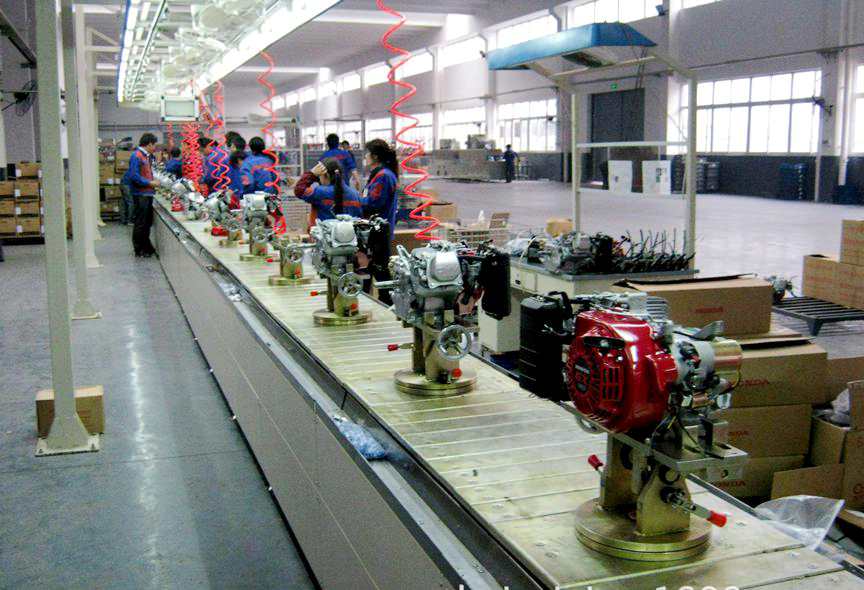
Adopting a configuration of slat-chain conveyor plus dedicated fixtures, the portable gasoline generator assembly line mainly consists of three parts:
(1) Slat-Chain Conveyor
The slat-chain conveyor serves as the main conveying unit of the assembly line. It is assembled from standard metal chain plates installed on steel structural frames. Boasting high load-bearing capacity, the slat-chain conveyor stably supports the weight of engine cylinder blocks and bottom-mounted fixtures. Driven by electric motors, its conveying speed is regulated via variable-frequency speed control. The flat chain-plate surface is suitable for placing tooling fixtures, and the conveyor features wear resistance, corrosion resistance and convenient maintenance.
(2) Dedicated Positioning Fixtures
Fixtures are key components of the assembly line. Each workstation is equipped with a set of metal fixtures perfectly aligned with the mounting holes on the engine base. Quick-clamping mechanisms secure engines at preset positions to prevent displacement during assembly. Locating pins and support blocks on fixtures guarantee consistent engine orientation in three-dimensional space, facilitating operators’ tightening, plug-in and other operations. Each fixture is fitted with an oil-collecting tray to contain spilled engine oil during assembly and keep the workplace clean.
(3) Pneumatic Auxiliary System
Aluminum-alloy slide rails are mounted above the production line, suspending red polyurethane spiral air hoses. Quick-connect couplings are fitted at hose ends, allowing operators to connect pneumatic wrenches, pneumatic screwdrivers, pneumatic presses and other tools as needed. The pneumatic system provides stable assembly power, reduces manual labor intensity, ensures that bolt-tightening torque at critical positions meets process specifications, and improves product consistency.
The assembly workflow for a small gasoline engine or a complete portable gasoline generator on this production line is described below:
1. Sub-Assembly and Pre-Assembly Stage
Certain complex or time-consuming components are pre-assembled on workbenches beside the main line, including: adjusting valve clearances to specified values; installing piston rings and verifying gap positions; checking alignment marks on timing chains or timing gears; pre-mounting carburetors, air filters, ignition coils, spark plugs, etc. Pre-assembled modules are transferred to corresponding stations on the main line for final assembly.
2. Cylinder-Block and Crankshaft-Assembly Installation
Place the left crankcase or cylinder block onto the dedicated fixture of the slat-chain conveyor for positioning and clamping. Operators sequentially fit main bearings, crankshaft assemblies coated with clean engine oil, connecting rods and connecting rod bearings, and the right crankcase cover, then tighten crankcase bolts to specified torque. Install the oil sump and connect oil-pump transmission components. Strict cleanliness requirements apply at this stage to avoid foreign-matter ingress into the crankcase.
3. Cylinder-Head and Valve-Train Installation
Position a cylinder-head gasket on the top face of the cylinder block, then hoist the pre-assembled cylinder-head assembly (fitted with valves, valve springs and camshaft) into place. Using torque wrenches, tighten cylinder-head bolts in 2–3 incremental passes following a cross-tightening sequence from center to both sides. This ensures uniform stress on the cylinder-head gasket and prevents gasket blow-out. Mount the valve-chamber cover, rocker arms and other components afterwards.
4. Peripheral-Accessory Assembly
As the slat-chain conveyor advances, complete the following assembly tasks station-by-station: install the oil pump and oil pipelines; fit water pumps (water-cooled models) or air shrouds and heat sinks (air-cooled models); mount starter motors or magnetos; connect fuel switches, fuel hoses and carburetor fuel-inlet lines; install intake-exhaust manifolds and mufflers; plug in high-tension ignition-coil cables, charging-coil wiring harnesses, electric-start relays and other electrical connectors. At this point, assembly of the engine main body is finished.
5. Electrical Fitting and Final Commissioning
For complete portable gasoline generator assembly, align and couple the engine with the generator head (stators, rotors and end covers), and mount shock-absorbing blocks and frames. Fill with engine oil and gasoline of designated grades, and connect storage batteries (for electric-start versions). Perform initial startup on test benches; inspect idle speed, acceleration response, maximum power output, as well as voltage and current stability. Carry out exhaust-gas testing, noise measurement and leakage inspection (for engine oil, gasoline and exhaust gas). Qualified units proceed to subsequent processes (packaging or painting); non-conforming units are routed to the rework area.
To accommodate factory-building conditions, product types and capacity requirements of different customers, all parameters of this portable gasoline generator assembly line are customizable. The table below lists available customizable parameters:
| Parameter Category | Customization Options / Range | Detailed Description |
|---|---|---|
| Line Length & Workstations | 3–20 workstations; line length: 6–40 m (customizable) | Flexibly designed according to workshop layout; workstation spacing: 1.5–2 m |
| Conveying Speed | 0.5–5 m/min stepless speed regulation | Driven by variable-frequency motors; cycle time configurable from 20 s to 5 min |
| Fixture Compatibility | Quick-change locating pins, adjustable support blocks | Compatible with multiple-displacement models such as 2 kW, 3 kW, 5 kW; model change-over time < 10 minutes |
| Slat-Chain Material | Galvanized carbon steel, 304 / 201 stainless steel | Selected according to service environment: standard industrial grade or anti-corrosion grade |
| Air-Source Pressure | 0.5–0.7 MPa | Matched with centralized workshop air-supply system; optional hose diameters |
| Power Configuration | 0.75 kW–3 kW motor; gearbox optional | Selected based on line length and load |
| Electrical Control | Ordinary push-button control or PLC touch-screen control | PLC system stores multiple production programs for automatic cycle-time control |
| Auxiliary Equipment | Automatic torque-controlled tightening machines, automatic glue applicators, cold-test benches, hot-test benches, ANDON pull-cord switches, data acquisition systems | Optional upgrades for higher automation and quality traceability |
| Workstation Facilities | LED workstation lamps, anti-static rubber workbenches, parts transfer carts | Improve operating conditions and protect precision parts |
| Safety Protection | Emergency-stop buttons, overload protection, chain anti-fall-off devices | Safeguard personnel and equipment |
Through flexible combination of the above-mentioned parameters, enterprises can deploy portable gasoline generator assembly lines well-suited to their product characteristics. Suitable configuration schemes are available both for small-batch multi-variety production by start-up manufacturers and for large-scale production by established manufacturers. Custom-designed fixtures and control systems enable fast change-over between different portable gasoline generator models on one production line, improving equipment utilization and lowering overall manufacturing costs.
Previous: Pressure fan assembly line